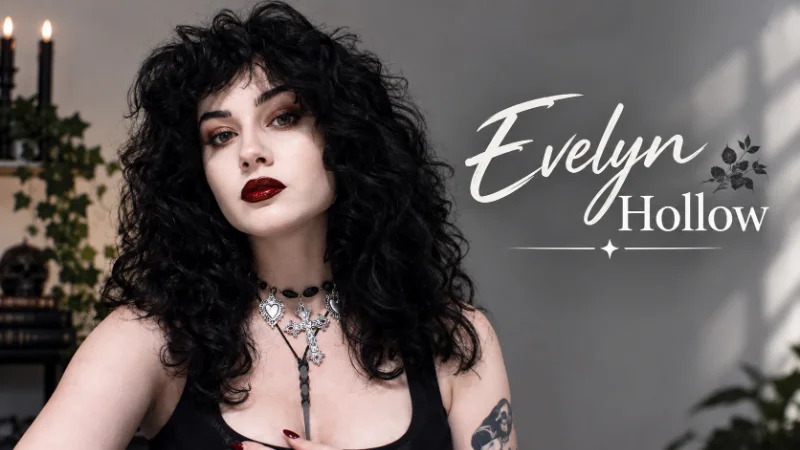
Evelyn Hollow is the resident “believer” on the BBC series The Battersea Poltergeist and Uncanny, and she is a Scottish paranormal psychologist, author and broadcaster. She is a former psychology lecturer with a Master of Research degree in Paranormal Psychology. Since then she has added television work, a Radio 4 Extra special on The Wicker Man and two books from Quarto’s Ivy Press imprint.
Readers who search her name usually want to know who she is, what she has worked on and where to start. This guide covers all three. It also says plainly which details, including her age and net worth, are not publicly confirmed.
Who Is Evelyn Hollow
Hollow is from Scotland, and she told New Internationalist magazine that Edinburgh is her home town. Her background is academic before it is broadcast. She lectured in psychology and holds a research master’s in paranormal psychology.
Event and interview bios also call her a writer, curator and editor. She gives guest talks on paranormal history and the quantum physics of anomalous phenomena. Her work now runs across radio, television, live events and print.
From Forensic Psychology to Paranormal Research
She did not begin in the paranormal. In an interview with Science Fiction Bulletin, she said she first trained as a forensic psychologist, then switched because she knew she would otherwise lie awake wanting to explain paranormal experiences.
That origin explains her method. Her starting question is what a person is actually experiencing, which is a psychologist’s question before it is a ghost hunter’s.
Before television, Hollow spent six years working in Edinburgh bars, and she has said that stretch gave her plenty of exposure to the so-called lunar lunacy effect. That is the folk belief that a full moon changes how people behave. She describes her first book as drawing on a long interest in how belief works across cultures.
The Battersea Poltergeist and the Believer Role
BBC Radio 4 first broadcast The Battersea Poltergeist in March 2021, written and presented by Danny Robins with Ciarán O’Keeffe and Evelyn Hollow as the experts. It revisited a haunting that had been national news in the 1950s.
Hollow has said she assumed at first that Robins meant the 1920s Harry Price case. She had never heard of a poltergeist case running anywhere near 12 years, and she notes it was even discussed in the House of Commons.
The series won Gold for Best Serialized Podcast at the 2021 New York Festivals Radio Awards. That award went to the series, and Hollow was one of its experts.
Working Opposite a Skeptic
On both shows, Hollow plays the believer and Ciarán O’Keeffe the skeptic. They are also friends and fellow psychologists, and she says they agree on more than they disagree.
A reviewer at the live Battersea Poltergeist show on Halloween noted that the two experts brought opposing views to the events. That is the strength of the format. Neither expert is a caricature, so listeners have to weigh the evidence themselves.
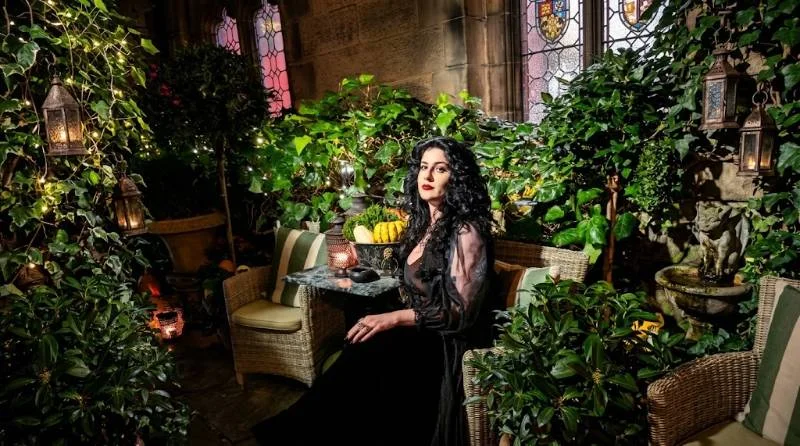
She has also talked about audience expectations. People assumed she would be blonde or 50, she told New Internationalist, and she joked that they did not expect an “Elvira-looking goth bird.”
Uncanny on Radio, Stage and Television
The BBC announced Uncanny as a fifteen-part series from the Battersea team, with Robins joined by paranormal psychology specialists Chris French, Ciarán O’Keeffe and Evelyn Hollow. It reached BBC Sounds on October 20, 2021, with Radio 4 broadcasts starting three days later.
Robins said the show grew out of the personal ghost stories listeners sent after Battersea. Hollow tells it the same way: so many people wrote in that Robins was overwhelmed.
Uncanny then moved beyond audio. In late 2023 she was on the Uncanny tour, and she had also contributed to The Witch Farm. In a later interview she said she was filming the second season of the BBC television adaptation.
She also appears on her own. An Evening With Evelyn Hollow, staged as part of Farsley Lit Fest in Leeds, paired a talk on her first book with an audience Q&A. She was also listed in the lineup for the 2025 UK Ghost Story Festival.
Spooked Scotland, Spooked Ireland and The Wicker Man
Hollow is a regular in reality-documentary formats too. Her publisher bio describes her as one of four team members on Spooked Scotland, set to air on the Discovery Channel in May 2022.
Spooked Ireland followed on discovery+, with its first episode airing on September 29, 2023. Hollow joined medium Chris Fleming and researcher Ryan O’Neill under presenter Vogue Williams, and the ten-episode run opened at Charleville Castle. That castle later became an entry in her book Atlas of Paranormal Places.
The radio work has the clearest tie to her roots. For the 50th anniversary of The Wicker Man, she presented a BBC Radio 4 Extra special that aired on December 2, 2023, after producer Stuart Ross approached her.
Her reasons were plain: she is a fan of Christopher Lee, the film was shot in Scotland, and it shaped folk horror.
Atlas of Paranormal Places
Atlas of Paranormal Places is her first book, published by Ivy Press, part of the Quarto group, in September 2024. It runs 224 pages and covers more than 50 locations, with a foreword by Danny Robins.
The sites range widely. The Chase Vault in Barbados, a crypt known for its moving coffins, sits beside the witch market in La Paz, Iceland’s Gunnuhver Mud Pool and Turkmenistan’s Door to Hell, a crater that has burned for about half a century. One NetGalley reader also lists Sarah Winchester’s house and Japan’s Aokigahara Forest among the entries.
What separates it from a standard haunted-places list is the editorial filter. Hollow has said she left out places she considers fraudulent or unethical. She kept a few with no paranormal ties but a rich history, and she stated her professional assessment of them.
Readers have noticed the tone. A NetGalley reviewer described her writing as warm and fair to both skeptics and believers. The Society for Psychical Research also carried a review of the book.
Hollow’s Hauntology and the Move Into Mythology
Her second book moves from places to the beings people imagine. Hollow’s Hauntology is a 192-page hardcover from Quarto, published on September 10, 2026, and priced at $26. It covers 80 legendary beings across eight chapters.
The approach is psychological as much as folkloric. According to the publisher, the vampire chapter traces figures from Croatia’s strigon to China’s jiangshi back to shared anxieties about death and disease. Other chapters look at animal transformation and at how political, religious and cultural forces turned gods into demons.
Read together, the two books split the question. Atlas asks where people sense the uncanny, and Hauntology asks why they needed the story in the first place.
Her ideas about ghosts are still developing in public. On the Spill The Spirituality podcast she discussed a theory that ghosts could be glimpses through time.
Awards, Age and What Is Not Confirmed
Quarto’s author bio calls Hollow a double Academy Award winner. None of the sources reviewed for this article names the awards, the ceremony or the years. Treat the claim as self-described until a named record turns up.
The recognition that is documented is the Radio Award mentioned earlier, which went to the Battersea series.
Her date of birth, net worth and relationship status are not publicly confirmed, so none of them appear here. Figures for any of them on other sites deserve the same caution.
What Sets Her Approach Apart
Paranormal media tends to split into two camps, the credulous and the dismissive. Hollow works in the gap, as an openly sympathetic expert who still shows her reasoning and says so when a famous case is weak. Cutting dubious locations from Atlas is the clearest example.
There is a fair counterpoint. Casting her as the believer is a format choice, and a listener who wants pure debunking may find her readings of cases generous. Her own account of working with O’Keeffe suggests the arrangement is closer to a conversation between friends than a contest.