
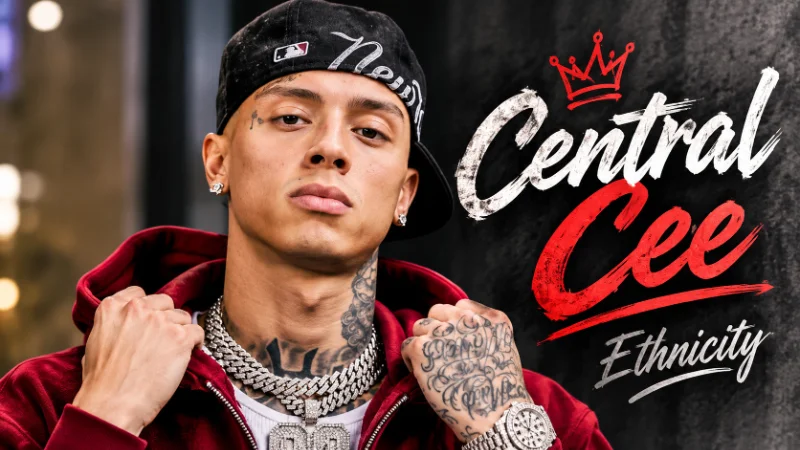
Central Cee is of mixed heritage: his mother is English and his father is Guyanese and Chinese. The London rapper confirmed this himself in a March 2023 interview with British Vogue, and it remains the clearest first-hand answer to the Central Cee ethnicity question that fans keep searching.
The short answer leaves a lot unexplained. Guyanese and Chinese ancestry has a specific history, several popular websites contradict his own words, and the topic often gets tangled up with his nationality and his religion. This article separates what he has confirmed from what other sites have added, and explains what that family background actually means
What Central Cee Has Said About His Background
Oakley Neil Caesar-Su was born on June 4, 1998, in Ladbroke Grove, London, to an English mother and a father of Guyanese and Chinese ancestry. The most direct wording comes from the Vogue interview, where he told the writer, “My dad’s Guyanese and Chinese, and my mum’s English.” The writer noted that he hesitated before answering.
His mother, Rachel Caesar, met his father when she was 15 and kept dating him against her parents’ wishes, after which she was cut off financially. That detail comes from a 2023 Guardian interview, as summarized on Wikipedia. His parents separated when he was seven, and he moved with his mother and two younger brothers to Shepherd’s Bush in West London.
That early financial strain follows him into his later interviews. The Guardian headlined its 2023 profile with his admission that he feels survivor’s guilt and does not think he deserves his success.
He also has a half-brother, and one of his brothers, Juke Caesar, appeared on the 23 mixtape under the name “Lil Bro.” His mother worked as a social worker, and as a child Central Cee wrote poetry and raps that he showed to her. Central Cee turned 28 in June 2026.
Nothing more about his father’s family is public, and this article does not guess. His mother’s surname, Caesar, matches the first half of Central Cee’s own, but no source reviewed explains the second half, Su.
Where Guyanese and Chinese Roots Meet
A Chinese Guyanese background traces back to the 1800s, when Chinese laborers were brought to what was then British Guiana to work on sugar plantations. Guyana is a small country on the northern coast of South America, and its population was built largely by people who arrived as slaves or indentured workers.
How Chinese Labor Reached Guyana
The term Chinese Guyanese refers to Guyanese nationals of Han Chinese descent. The first Chinese laborers arrived on January 12, 1853, a date Guyana now marks as Chinese Arrival Day. Between 1853 and 1879, 13,541 Chinese people landed in the country, the smallest group among the indentured workers brought there. The Guyana Chronicle reports that most were Cantonese in origin.
Contracts ran five years, with pay of $4 a month plus food, according to historian Odeen Ishmael. Official figures for the first ships differ, since two speeches from Guyana’s Office of the President give 647 arrivals in one and 262 plus 85 in another, so exact first-voyage numbers are best treated with care.
They were sent to sugar plantations in three counties, Berbice, Demerara, and Essequibo. The early arrivals were men, and a small number of Chinese women came later. Over time the community built its own institutions, including a Chinese Association, a sports club, and an Anglican church founded and run by Chinese Guyanese.
The community went on to produce Arthur Chung, who became independent Guyana’s first president and held the office from 1970 to 1980. He was also the first Chinese head of state of a country outside Asia. After independence, many Chinese Guyanese professionals emigrated, and the group today is mainly a diaspora community. Wikipedia lists the population inside Guyana at 1,637 people, about 0.18 percent of the country.
How Central Cee’s father’s family reached London has not been made public. The emigration history above is context, not a claim about their route.
What the Word Guyanese Covers
Guyana’s population descends from Indigenous peoples and from enslaved and indentured people who came from India, Africa, Portugal, and China, according to a country summary on ecoi.net that cites the 2002 census. That mix is why the word Guyanese says little about ancestry on its own. A Guyanese person can be of African, Indian, Indigenous, Portuguese, Chinese, or mixed descent.
In this rapper’s case, the Guyanese label comes paired with Chinese, and that pairing is the specific detail he gave. It is also the detail most often dropped when his background gets summarized in a few words.
Growing Up in West London With a Mixed Background
Central Cee grew up in Shepherd’s Bush after his parents separated. On visits to his father, Central Cee was shown hip-hop, and at Notting Hill Carnival he heard reggae and dancehall. He attended the same school as the rapper Digga D, who is two years older. He left school at 16, and music was already the goal by then, since a friend had taken him to a studio near Wandsworth Bridge when he was 14.
The path there was gradual. At 17 he rented Hoxton Square Bar & Kitchen for £500 and made £2,500 in profit from his first headline show, and he met his future manager, YBeeez, in 2019. Central Cee’s breakout arrived in 2020 with the drill singles “Day in the Life” and “Loading.”
His 2025 debut album, Can’t Rush Greatness, reached number nine on the Billboard 200 and became the first UK rap album to land in that chart’s top ten. That scale of fame explains why his family background gets searched so often. Capital XTRA, a London radio station, published a full explainer covering his ethnicity, height, real name, and religion.
Why the Vogue Interview Is the Reference Point
Several outlets, including Wikipedia, Kiss, and Briefly, trace the family details to one source. British Vogue ran the interview in March 2023 and later republished it from its archive under a headline about clearing up misconceptions.

The Guardian interviewed Central Cee a few weeks later, in April 2023, and Wikipedia draws on both pieces for his family history. The two interviews agree on the broad outline: an English mother, a Guyanese and Chinese father, a split when he was seven, and a childhood in West London. Wikipedia’s account of his family, built on those pieces, mentions neither Irish nor Ecuadorian ancestry. Wikipedia, Capital XTRA, and Kiss all repeat the same parentage.
For readers checking the claim themselves, the March 2023 British Vogue piece and the April 2023 Guardian interview are the two primary sources to open first.
Claims About His Ethnicity That Do Not Hold Up
Two claims appear again and again online and conflict with what Central Cee said: an Irish mother and Ecuadorian ancestry on his father’s side.
1: The Irish Mother Claim
Briefly, a South African news site, writes that his mother is Irish and ties the family details to the March 2023 Vogue interview. The interview quote says English. Irish ancestry somewhere in her family tree is possible, but no source reviewed for this article names one.
2: The Ecuadorian Claim
A handful of small blogs add Ecuadorian descent to his father’s side. None of the pages checked named a source, and neither Wikipedia nor Capital XTRA mentions it. Until a verifiable source appears, it should be treated as unconfirmed.
3: Is Central Cee Black?
Searches for this question usually start from the word Guyanese. Capital XTRA describes him as mixed ethnicity with an English mother and a Guyanese-Chinese father, and Central Cee’s own statement names English, Guyanese, and Chinese roots. No source reviewed for this article attributes African ancestry to either parent.
The accurate short description is mixed heritage, which in everyday terms means multiracial. For a one-line description in writing, British rapper of English and Chinese Guyanese descent matches what he has said.
Ethnicity, Nationality, and Religion Are Separate Questions
Nationality is a legal status, ethnicity describes ancestry and cultural background, and religion is a matter of belief. Central Cee is British by nationality, born in London and raised in the western part of the city. His ethnicity is mixed English, Guyanese, and Chinese. Religion is a third question with its own answer.
Capital XTRA reported that fans had speculated for some time that he was Muslim, partly because of an Arabic caption on his Instagram in September 2023. The speculation ended on February 6, 2026, when he announced during a livestream with PlaqueBoyMax that he had converted to Islam and changed his name to Akhil. Converting to a religion does not alter ancestry, so his faith belongs in a separate answer from his heritage.
How He Has Acknowledged His Roots in Public
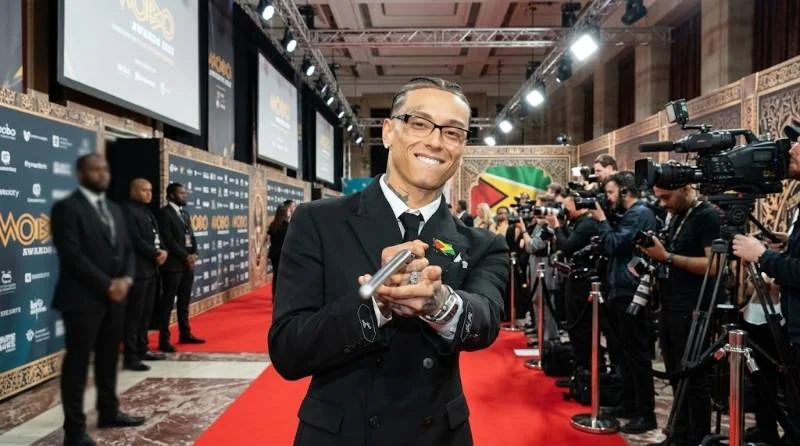
At the 2025 Met Gala he wore a custom Jacquemus suit with a brooch of Guyana’s flag, which Rolling Stone UK described as a nod to his father’s heritage. The event’s theme that year was Superfine: Tailoring Black Style, and the brooch sat alongside a Richard Mille watch and rings in Rolling Stone UK’s description of his look. Capital XTRA also read the pin as a way of representing his Guyanese side. It is the clearest public gesture toward Guyana in the sources reviewed.
In the same Vogue interview, Central Cee spoke about absorbing his mother’s hardships and wanting to take matters into his own hands. In the sources reviewed, he has said little else on the record about his roots. British Vogue later gave him its July 2024 Style & Sound cover, which Kiss reported made him the third solo male cover star in the magazine’s history.
How Reliable Each Claim Is
The claims about his background fall into three groups, depending on who stands behind them.
- Confirmed by Central Cee himself: an English mother and a Guyanese and Chinese father, from the March 2023 British Vogue interview.
- Widely reported by named outlets: the Guyana flag brooch at the 2025 Met Gala, covered by Rolling Stone UK and Capital XTRA, and the family details repeated on Wikipedia.
- Not supported by a named source: Irish ancestry on his mother’s side and Ecuadorian ancestry on his father’s side.
What Is Still Not Publicly Confirmed
Several details remain open, and this article leaves them open.
- Where in Guyana his father’s family comes from, and how they reached London.
- Whether any other ancestry exists beyond what Central Cee has named.
- The origin of the surname Su.
- Any specific Irish or Ecuadorian connection.